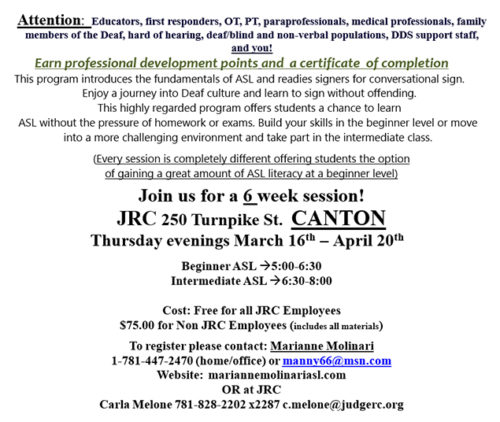
JRC is pleased to partner with American Sign Language certified teacher, Marianne Molinari, to offer a 6-week series of classes in ASL, beginning May 1, 2014.
This program introduces the fundamentals of ASL and readies signers for conversational sign. Enjoy a journey into Deaf culture and learn to sign without offending. This highly regarded program offers students a chance to learn ASL without the pressure of homework or exams. Each 6 week beginner program offers NEW lesson plans which are functional in nature and prepare students for true conversational dialogue.
Who should learn?
Learn American Sign Language
Educators,
first responders,
OT,
PT,
paraprofessionals,
medical professionals,
family members of the Deaf, hard of hearing, deaf/blind and non verbal populations,
DDS support staff , and
you!!!
EARN Professional Development Points (PDP’s) and Paramedic/EMT Credits! A certificate of completion will be awarded to all attendees at the last class.
Join us for the next 6 week session!
Where: Judge Rotenberg Center 250 Turnpike St. Canton MA When: May 1st – June 5th
As the Referrals Director at JRC, I have the opportunity to encounter a number of agencies that deal with a very difficult population of developmentally and emotionally disabled individuals.
These agencies include school districts, psychiatric hospitals, public and private mental health agencies, and criminal courts and affiliated agencies, as well as other service providers. Most often I am visiting these agencies because they have come in contact with a student who has defied other means of treatment or has such difficulties in his or her current setting, that no other program is able to offer educational services.
As all of my colleagues here at JRC do, I stress our ability to effectively educate students without the use of medication, and our willingness to accept even the most difficult students without the threat of expulsion. Often parents and agencies have received assurances from programs that they are able to manage students with severe maladaptive behaviors, only to have the child referred back to the school district or mental health agency that is responsible for ensuring educational and treatment services.
When my colleagues and I meet with agencies and assure them that we are committed to working with the most difficult to treat individuals, we are often met with a fair amount of skepticism. It is gratifying to have the opportunity to work with students who have been expelled or rejected from other programs and see them realize significant progress and achieve goals that they did not think were possible.
JRC student concentrates on her academic work at her classroom computer.
I recall one young lady who was brought before a Family Court Judge in New York City after having been charged with criminal offenses. The Judge felt that due to the adolescent’s criminal behavior and gang activity, she was not worthy of placement in a private school, which was evidenced by her behavior in court. At the time, the young lady refused to properly address the Judge; she refused to remove her feet from the table and would not take her hat off. The Judge was also concerned that the young lady would elope (run away) once admitted to our school, and offend once again in the community. In spite of her reservations, the Judge was convinced to allow the girl to be admitted to our school. However, the Judge did offer a stern warning that the girl was due back in court in several weeks and the court would not be pleased if the girl failed to attend the hearing or committed another criminal offense.
When we returned to court several weeks later for a subsequent appearance, our student was in a much better frame of mind than at her previous appearance. She was genuinely happy and sociable. Her attire and manners were appropriate and she was very cordial. When the Judge met with her, she was astounded at the transformation in this young lady. Our student stood up when the Judge entered the courtroom, addressed the court in a pleasant manner and thanked the Judge for the opportunity to attend school. The Judge was speechless and could only shake her head.
After a minute or so, the Judge asked our student if she was taking medication and our student exclaimed, “No, they don’t make me take medication.” The Judge then asked our student to what she attributed such a drastic change in her behavior and demeanor. Our student explained that she had never been treated with such respect, in spite of some difficult behavior that she was displaying in the first several weeks of her admission to JRC. She told the Judge, “No matter how bad I am, they still treat me well and take good care of me. I really want to get my education.” The Judge looked at me and said, “I don’t know how you people did it, but I can’t argue with the results. I am quite pleased with the progress of this young lady”.
I have been before this Judge since then and her skepticism has disappeared.
April is Autism Awareness Month, and Major League Baseball is partnering with Autism Speaks in order to raise awareness and support. Part of the proceeds from ticket sales will go toward Autism Speaks’ efforts to increase awareness, fund innovative autism research and family services, and advocate for the needs of individuals with autism and their families.
Many of the MLB Autism Awareness games will provide special opportunities and a safe, friendly environment for families and individuals affected by autism, allowing them to experience a game like never before.
Boy giving the “play ball!” command at a Red Sox game. Image courtesy of AutismSpeaks.orgWorking with Autism Speaks or other autism awareness organizations, many clubs will recognize local families during pregame ceremonies. Additionally, in select ballparks, members of the autism community can enjoy the game from designated “Quiet Zones” with a sensory-friendly environment, as well as participate in various traditional baseball activities, including throwing out the first pitch, singing the national anthem, announcing “Play Ball!”, singing “Take Me Out to the Ballgame”, and performing “God Bless America.”
This year, Autism Speaks created a Guide to the Game, a visual story to help prepare children and adults with autism for a day at the ballpark by walking them through the full experience in detail ahead of time. The special accommodations enable many families affected by autism to attend their first MLB game.
The Applied Behavior Analysis (ABA) literature is consistent with regard to the value of thorough and precise assessment of the functions of dangerous/disruptive behaviors. Such assessment (whether experimental functional analysis or descriptive functional behavioral assessment) can help to form the development of a behavior intervention plan that is better tailored to the individual’s clinical needs.
At JRC, assessment of the functions of student problem behaviors is ongoing throughout the student’s JRC enrollment. When the student is first admitted to JRC, a reinforcer preference assessment occurs over the course of the student’s first week. Data are taken regarding which stimuli/events may serve as motivating rewards in the student’s BIP.
Simultaneously, the student’s JRC Clinician begins to collect data, across all environments, on the student’s positive and negative behaviors, as well as related triggers and consequences. Assessment methods include interviews and questionnaires administered to the student, family, and staff; collection and graphing of a broad range of behavioral frequency data 24 hours per day; and direct observation of the student across all natural environments.
JRC’s main video monitoring suite enables views of all JRC spaces.Direct observation, a cornerstone of good ABA, is particularly easy to do at JRC because of JRC’s Digital Video Recording (DVR) system. Most environments (e.g., classrooms, group homes) are equipped with DVR cameras so that JRC Clinicians are able to observe their students’ behavior and related environmental antecedent and consequent events.
JRC’s specialized standard celeration behavior charting system, when combined with the direct observation capability provided by JRC’s DVR system, means that JRC’s Clinical staff are able to conduct ongoing and comprehensive functional assessment throughout the student’s enrollment at JRC. Such ongoing and comprehensive functional assessment is an improvement upon the once-per-year static and narrowly focused functional assessment that sometimes occurs at other settings. For more information regarding JRC’s functional assessment methods, please feel free to reply to this post.
I am both a parent of a child with several emotional and behavioral issues, and an employee of JRC for over 17 years. When I began in 1997 as a Mental Health Assistant (direct care staff), I was amazed at how well-kept the facility and residential homes are. The facility had an “at home atmosphere” for all the students and clients but they are also well-monitored by cameras and staff.
The author with one of her favorite clients.
However, what were most impressive to me were the students and clients. They come in from all around the world to receive our services. Despite all of the negative perceptions and ongoing controversy, we have been very successful in providing our students and clients a better quality of life.
Because my child is also one who needs help, I can sympathize with the parents who struggle day in and day out just hoping to find a place where their child is getting the services they not only need but deserve. As both a parent and an employee, I can see that JRC has been and continues to be that place for our students and clients.
As I continue my employment with JRC, I recognize how privileged I am to be working at the center with so many dedicated professionals, and as I continue to grow older I will cherish all of my memories of the students and clients I have met throughout the years.
I’m a software developer at JRC and I would like to briefly talk about the charting application that we have developed here at JRC that I feel greatly benefits our students and clients and our staff.
The charting application graphically displays client academic and behavioral data that we collect at the school. Academic data is collected and displayed in real time. We have students and clients work in several different educational applications throughout the school day. As he or she completes a timing, the results are written to our charting application which can be displayed instantly. Daily behavioral data is collected and entered by staff usually a day or two later. Staff use the charting application to easily monitor how the student or client is doing both academically and behaviorally.
Being able to easily access this data and being able to visually see this data is a huge help to staff in helping students and clients obtain the best care here at our school. One last benefit that I would like to add is that parents can view their child’s chart data at any time via our Parent Agency website.
This chart shows the drop-off in this student’s inappropriate behaviors from entry to JRC to the present.
JRC has made use of custom software applications in order to maximize the work efficiency of staff and to more adequately manage big data.
Because of the large amounts of data needed to be recorded due to the nature of our business, JRC has built many systems in-house in order to manage this workload. From a scheduling system that processes a constantly changing schedule for 1000 staff at 40+ locations 24/7, to a program change application that allows clinicians and case managers to make dozens of changes per week to client’s programs, custom software has allowed the organization to more easily manage the growth of information needed to provide effective aid to our students and clients.
Let us know if you would like to learn more about some of the software programs we have been able to develop here.